Interview
Meet the Team
Logistics, finance, commercial, technology — meet the experts who make it happen. Follow our mini-interviews to see who’s moving the industry forward.
Logistics, finance, commercial, technology — meet the experts who make it happen. Follow our mini-interviews to see who’s moving the industry forward.
At Loads, we believe the future of international food trade lies in combining smart technology with strong human relationships.
In this edition of #MeetTheTeam, we sit down with Hugo Constanzo, Product Owner at Loads, to talk about how he’s helping optimize processes, reduce operational friction through automation, and build digital platforms that bring greater transparency, efficiency, and peace of mind to customers — while exploring the growing impact of AI in global trade.
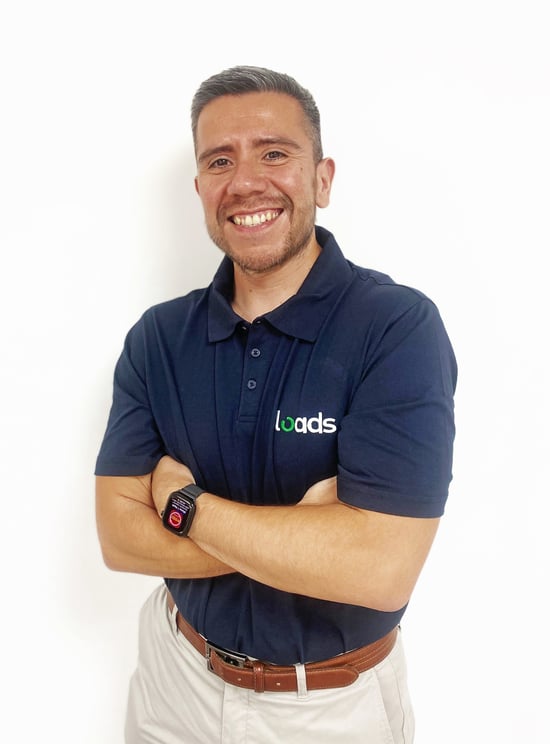
I’m a Product Owner at Loads, and my main focus is designing and evolving digital platforms that facilitate international food trade.
Right now, we’re strongly focused on deeply optimizing our processes. That means understanding in detail how each operational task is carried out, where friction points appear, and which parts of the workflow still depend on manual work. Based on that knowledge, we continuously assess what should be automated and how to do it properly, with the goal of reducing operational time, errors, and manual workload.
But this work isn’t only internal. We are constantly monitoring our customers’ needs, understanding their operational challenges and the level of visibility they require over their shipments. Our objective is to bring real value to their operations and provide peace of mind during critical moments, such as the arrival of their products.
In parallel, I work on connecting data, processes, and people so that commercial and financial decision-making becomes simpler, more transparent, and more efficient. Every improvement we prioritize is meant to drive growth, increase efficiency, or reduce risk.
My role combines product strategy, coordination with my team, and close collaboration with business areas. A typical day includes analyzing metrics, defining priorities, having conversations with stakeholders, studying user behavior, and designing solutions together with the team.
I always try to balance analytical thinking with creativity: understanding the problem through data, while also imagining solutions that truly delight customers and generate impact in terms of growth, efficiency, or risk reduction.
I’ve learned that international food trade is much more human than it seems. Behind every operation, there is trust, timing, and risk management.
I also realized that the cold, traditional e-commerce approach doesn’t work well in this industry. Here, relationships are built through conversation, negotiation, and personalized communication. Many times, a phone call or a WhatsApp message creates more progress than a fully automated platform.
Technology is not here to replace that human connection, but to strengthen it: it organizes information, provides visibility, and reduces friction, but the commercial relationship is still between people. When you combine digital tools with genuine closeness, you create stronger relationships and more sustainable business.
The biggest shift is the true digitalization of the sector — moving from processes based on emails and spreadsheets toward connected digital ecosystems where information flows in real time.
This will bring greater traceability, improved risk management, and more predictive decision-making. Those who adopt technology in an intelligent way will gain a major competitive advantage.
Making decisions based on impact. We always ask ourselves: does this drive growth, improve efficiency, or reduce risk? That framework helps us prioritize effectively and avoid distractions from initiatives that sound good but don’t truly move the business forward.
I see Loads evolving alongside increasingly intelligent platforms, where technology supports customers in their daily decisions.
The goal is not only to digitalize processes, but to transform data into useful recommendations that simplify our customers’ lives. We want them to focus on what matters most — finding the product or service they need — while we take care of the operational complexity behind the scenes: documentation, digitalization, management, logistics, and quality, in a reliable and transparent way.
Every strategy, every innovation, and every connection starts with the people behind it. Stay tuned as we continue to highlight the leaders shaping the future of global food trade.


Logistics, finance, commercial, technology — meet the experts who make it happen. Follow our mini-interviews to see who’s moving the industry forward.
Logistics, finance, commercial, technology. Meet the experts who make it happen. Follow our mini-interviews to see who’s moving the industry forward.
Logistics, finance, commercial, technology — meet the experts who make it happen. Follow our mini-interviews to see who’s moving the industry forward.